Amjad Hussain Advocate Takes Oath as New Chief Minister of Gilgit-Baltistan
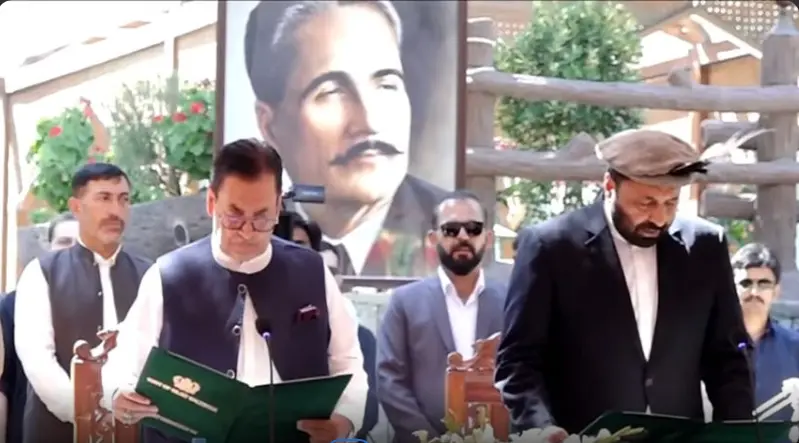
Gilgit: Advocate Amjad Hussain of the Pakistan Peoples Party (PPP) was sworn in on Monday as the new Chief Minister of Gilgit-Baltistan, in a ceremony held at Chinar Bagh, Gilgit, that had been delayed for nearly a week. The oath-taking had originally been scheduled for July 1 but was postponed after PPP chairman Bilawal Bhutto-Zardari travelled to Iran to attend the funeral of Ayatollah Ali Khamenei. Dawn
Who Is Amjad Hussain Advocate?
Amjad Hussain is a practising lawyer by profession and a senior PPP leader in Gilgit-Baltistan.Advocate Amjad Hussain has been elected to the Gilgit-Baltistan Assembly for a second consecutive term and is currently serving as the president of the Pakistan Peoples Party’s Gilgit-Baltistan chapter. He rose to the top office after his party emerged as the single largest force in the region’s newly elected assembly, positioning him as the consensus choice for the province’s top administrative post. Shafaqna Pakistan
The Oath-Taking Ceremony
After returning from Tehran, Skardu was reached by Bilawal Bhutto Zardari on Sunday, where he was received by Governor Syed Mehdi Shah, Chief Minister-elect Advocate Amjad Hussain, and senior Pakistan Peoples Party (PPP) leaders before being escorted to Gilgit for the oath-taking ceremony. Governor Mehdi Shah administered the oath of office to Hussain, formally installing him as the region’s chief executive. Dawn
The event carried symbolic weight beyond the swearing-in itself. Bilawal Bhutto-Zardari’s schedule included attending a memorial for the martyrs of the Gilgit-Baltistan War of Independence, where he addressed the gathering, before the oath ceremony took place. The PPP’s central and local leadership, members of the Gilgit-Baltistan Assembly, and senior government officials were present at the ceremony. Reports also indicate Bilawal Bhutto-Zardari is expected to finalize the composition of the new provincial cabinet during his visit. Dawn + 2
The Road to the Chief Minister’s Office
Hussain’s ascent to the top job followed a closely contested election and a period of coalition-building. General elections for the 24 directly elected seats of the 4th Gilgit-Baltistan Assembly were held on June 7, 2026, with the PPP winning ten general seats and PML-N emerging as the second-largest party with six. Independent candidates backed by PTI took two seats, Majlis Wahdat-e-Muslimeen won one, and five other independents later aligned with the Istehkam-e-Pakistan Party (IPP). WikipediaWikipedia
Since no single party crossed the 17-seat threshold needed to govern outright, the PPP and PML-N announced a power-sharing arrangement on June 20, under which the PPP secured the offices of Chief Minister and Speaker while PML-N took the Governor’s post, the Deputy Speaker’s office, and the role of Leader of the Opposition. The IPP subsequently announced its support for the PPP-led alliance on June 21. WikipediaWikipedia
On June 22, the newly elected assembly members took their oath, after which PPP’s Imran Nadeem Shigri and PML-N’s Malik Kifayatur Rehman were elected speaker and deputy speaker, respectively, both unopposed. Hussain then filed his nomination for chief minister, and with no rival candidate coming forward, he was declared elected unopposed later that evening. DawnDawn
Priorities and Challenges Ahead
Hussain inherits a province grappling with long-standing and increasingly visible grievances. Chief among them is an acute electricity crisis: officials have told parliamentary committees that summer demand in Gilgit-Baltistan reaches roughly 254 megawatts against a production capacity of only around 122 megawatts, leaving households and businesses without reliable power for hours at a stretch. World-energy
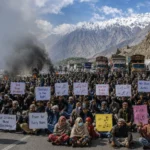
Public anger over the issue boiled over just days before the new chief minister’s swearing-in. Residents in Gilgit and Chilas staged protests against prolonged, unannounced power cuts during a summer heatwave, blocking the strategic Karakoram Highway in the Jutial area and chanting slogans against the authorities. Demonstrators pointed out that outages of over ten hours a day were continuing despite high river water levels — undercutting official claims made during winter that shortages were seasonal, with women in Oshikhandass also joining the protests over the issue’s impact on households. Republic WorldDevdiscourse
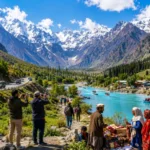
Beyond electricity, the new government faces pressure to expand tourism infrastructure — including airport capacity and planned ski resorts and cable car projects — while navigating chronic funding disputes tied to the National Finance Commission formula that governs how development money reaches the region. Analysts note that GB’s political landscape has also grown more fragmented in recent years, with local pressure groups and new parties channeling public frustration over unresolved economic issues, adding to the coalition management challenge facing Hussain’s administration.
Why This Matters for Gilgit-Baltistan
The transition marks the end of a caretaker administration that had overseen the region since late 2025 and the formal return of an elected government with a mandate to address issues that caretakers could not: long-term energy planning, tourism development, and budget allocation. Given the coalition nature of the government, how effectively the PPP-led alliance manages competing demands from its partners — and delivers visible relief on issues like electricity — is likely to shape public confidence in the new setup from its earliest days.
A Balanced Outlook
Hussain’s swearing-in closes out a multi-week process of elections, coalition talks, and assembly formation that began with the June 7 vote. It also comes at a moment when public patience over basic service delivery, particularly electricity, appears to be wearing thin, as evidenced by highway blockades just days before he took office. Whether the new government can convert its political mandate into tangible improvements for residents — without the disputes and disqualifications that have marked past administrations in the region — will be the central test of the coming months.