
Australian High Commissioner Meets GB Leadership to Discuss Education, Climate and Development
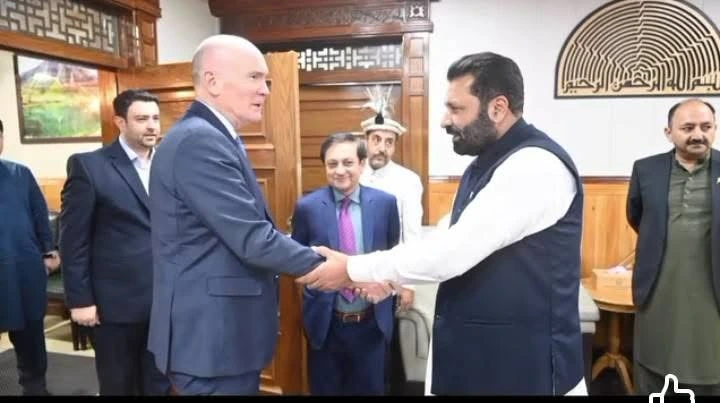
GILGIT: Australian High Commissioner to Pakistan Timothy Kane held a series of meetings with senior officials in Gilgit-Baltistan during his introductory visit to the region, with discussions focusing on education, agriculture, livestock, climate change, tourism and other areas of mutual interest.
Focus on Education and Opportunities for GB Students
During a meeting at the Governor House, Governor Gilgit-Baltistan Syed Mehdi Shah welcomed the Australian High Commissioner and called for stronger cooperation between Australia and Gilgit-Baltistan, particularly in education, agriculture and livestock.
The Governor urged Australia to increase scholarship opportunities for students from GB and support teacher training, fellowships and educational exchange programmes. He said greater access to international education could provide young people from the region with new opportunities and skills.
He also spoke about the impact of climate change and recent floods on agricultural land, crops and livestock. The Governor called for Australian technical assistance, expert exchanges and data-driven initiatives to improve the productivity and quality of local agriculture, fruits and livestock.
Australia Highlights Existing Cooperation
High Commissioner Timothy Kane said Australian institutions are already providing undergraduate and postgraduate scholarship opportunities to Pakistani students.
He also highlighted Australia’s support for initiatives aimed at improving dairy and meat production and livestock breeds. According to the High Commissioner, cooperation in livestock is already taking place in Gilgit-Baltistan in collaboration with the Aga Khan Development Network, with further details and future initiatives to be shared with the GB government.
Climate Change Remains a Major Concern
In a separate meeting, Chief Minister Gilgit-Baltistan Amjad Hussain briefed the Australian High Commissioner on the region’s development priorities and challenges.
Climate change was a major part of the discussion. The Chief Minister said Gilgit-Baltistan is home to around 800 glaciers and that rapid glacial melting has increased the risks of glacial lake outburst floods (GLOFs) and flash floods.
He said these changes are increasingly affecting communities, agriculture and local economies across the region.
GB Seeks Cooperation in Agriculture, Tourism and Energy
The Chief Minister also highlighted investment and development opportunities in energy, tourism, mining, agriculture, dairy and fisheries.
He discussed the government’s One Village One Product initiative, which aims to strengthen rural economies by promoting locally produced goods and creating better opportunities for communities.
Amjad Hussain also informed the High Commissioner about plans to establish a Glacier Protection Authority and efforts to attract international investment to Gilgit-Baltistan.
He sought Australian cooperation in climate change, modern agricultural technologies, education, scholarships and women’s empowerment. The two sides also discussed the possibility of introducing improved livestock breeds in Pakistan and Gilgit-Baltistan.
Search for Missing Australian Mountaineer
An important part of the meeting was the search for an Australian mountaineer who went missing while attempting K2 in 2022.
High Commissioner Timothy Kane requested the GB government’s assistance in the search. Chief Minister Amjad Hussain assured him that all available resources would be used to support efforts in this regard.
The issue adds a humanitarian dimension to the growing engagement between Australia and Gilgit-Baltistan, a region known for some of the world’s highest mountains.
Meeting with Gilgit-Baltistan Police Chief
During his visit, High Commissioner Kane also met Inspector General of Police Gilgit-Baltistan Dr. Akbar Nasir Khan (PSP) at the Central Police Office in Gilgit.
The IGP welcomed the visiting diplomat and presented him with a commemorative shield.
Strengthening Australia-GB Cooperation
The meetings highlighted the potential for stronger cooperation between Australia and Gilgit-Baltistan in several important areas, including education, agriculture, livestock, climate resilience, tourism and human resource development.
For Gilgit-Baltistan, where climate change is putting increasing pressure on communities and natural resources, partnerships that bring technical expertise, education opportunities and modern technologies could play an important role in the region’s future development.
The visit also reflects growing international interest in Gilgit-Baltistan’s development potential and its need for greater cooperation in dealing with climate-related challenges.